
Last updated: June 19, 2026
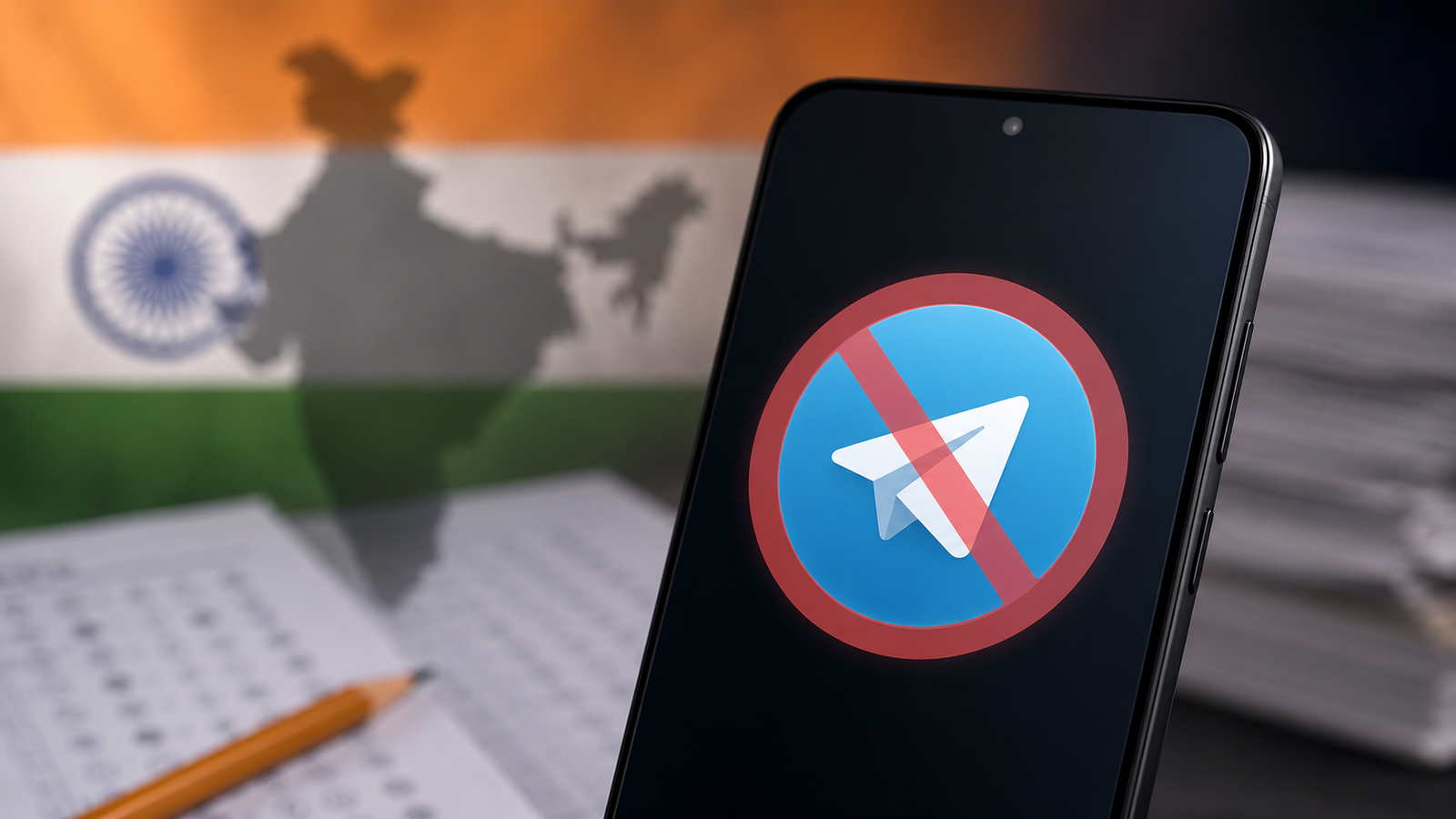
If you tried opening Telegram this week and found it wouldn’t load, you weren’t imagining it. The Indian government has temporarily blocked the app — and the reason has nothing to do with privacy crackdowns or geopolitics. It’s tied directly to one of India’s biggest and most sensitive exams: NEET-UG.
Here’s the complete, fact-checked breakdown of what happened, why, and when things go back to normal.
Quick Summary
- What happened: The Ministry of Electronics and Information Technology (MeitY) ordered telecom providers to block access to Telegram across India.
- When: The block took effect on June 16, 2026, and is set to be reviewed/lifted on June 22, 2026.
- Why: Organised cheating rackets were using Telegram to defraud NEET (UG) 2026 re-examination candidates with fake “leaked paper” offers.
- Legal basis: Section 69A of the Information Technology Act, 2000.
- Who asked for it: The National Testing Agency (NTA) formally recommended the action; MeitY issued the order.
- Extra restriction: Telegram has also been directed to disable its message-editing feature in India until June 30, 2026.
- Is it permanent? No. Officials have repeatedly described it as a temporary, exam-specific measure — not a ban on the app itself, and not related to free speech or national security in the way past app bans have been.
The Backstory: Why NEET and Telegram Keep Colliding
NEET-UG is India’s national medical entrance exam, and it’s been dogged by leak scandals and fraud rings for years. Telegram has long been on the radar of cyber law experts because its features make it a go-to platform for sharing files that would be difficult to share elsewhere — including pirated content and, in this case, claims of leaked question papers. Part of the problem is that Telegram has no physical office in India, which makes it unusually hard to hold accountable through normal regulatory channels.
This year, the trigger was the Re-NEET UG 2026 examination, scheduled for June 21, 2026, after the original exam had to be cancelled following leak allegations.
In the run-up to the re-exam, fraud networks set up Telegram channels with names like:
- “PAPER LEAKED NEET”
- “Re-NEET 2026”
- “Private Mafia”
- “REE NEET MAFIAA”
These channels demanded anywhere from a few thousand rupees to several lakh rupees from anxious students and parents, promising access to the “leaked” question paper. The NTA was blunt about it: there is no such paper available outside the secured examination chain, and any such offer is, in every instance, a fraud.
This isn’t a new pattern — similar Telegram-driven scams have surfaced around NEET exams in 2025, when Rajasthan Police had to warn aspirants and their families about fraudsters spreading misleading paper-leak claims through Telegram and social media, and even earlier, around the 2024 NEET and UGC-NET leak controversies.
What Finally Pushed the Government to Act
Authorities didn’t jump straight to a platform-wide block. The action followed formal recommendations from the NTA, with the Ministry of Electronics and Information Technology invoking Section 69A of the IT Act, 2000.
Before things escalated, enforcement agencies tried more targeted measures:
- Channel-by-channel takedowns coordinated by the Indian Cyber Crime Coordination Centre (I4C), under the Ministry of Home Affairs.
- State-level police action — the Ahmedabad City Cyber Crime Branch arrested individuals from Rajasthan on June 15 for allegedly running a fraud racket through Telegram, claiming to possess the NEET re-exam question paper.
- Police advisories in states like Bihar warning students not to fall for these scams.
According to the NTA, these targeted efforts removed a number of fraudulent channels, groups, and bots, but failed to produce adequate platform-level compliance, which is what led MeitY to describe the broader block as a “measure of last resort.”
Two Separate Orders, Two Different Timelines
It’s worth understanding that the government actually issued two distinct directions, not one:
1. The Platform Access Block (June 16 – June 22, 2026)
This is the headline-grabbing part — Telegram becomes inaccessible across Indian networks. The restriction runs until June 22, 2026, one day after the Re-NEET exam.
2. The Message-Editing Restriction (Until June 30, 2026)
This is the more technical, and arguably more important, part of the order. MeitY has directed Telegram to disable its message-editing feature in India, specifically targeting a method cheating rackets used to fabricate fake paper-leak “evidence.”
Here’s why that matters: Telegram’s edit feature lets administrators alter previously posted messages — including swapping out attached files — while keeping the original timestamp intact. Scammers were exploiting this to make it look like they’d posted a “leaked paper” before the exam even happened, when in reality they edited the message and file afterward. Disabling this feature doesn’t affect normal use of the app for sending and receiving new messages — it just closes off this specific fabrication trick.
The Legal Basis: What Is Section 69A?
Section 69A is a stringent provision of India’s IT law that empowers the government to block public access to online content or platforms in the interest of India’s sovereignty and integrity. It’s the same provision India has used in the past for high-profile blocks, including the 2020 ban on dozens of Chinese apps.
It’s worth noting that this provision has drawn criticism in other contexts. Digital rights activists have argued the provision is sometimes used in ways that curb free speech, though the government maintains it acts within the law and in the public interest. In this particular case, however, officials have been careful to frame the action as exam-fraud-specific rather than content- or speech-related.
Is This Ban Actually Working? (Enforcement Is Messy)
If you’ve heard conflicting reports about whether Telegram is accessible or not, that’s because enforcement has been inconsistent. Section 69A orders direct ISPs and telecom operators to implement the block themselves, and that rollout isn’t instant or uniform.
Real-world experience has varied by network — users on Jio, Airtel, BSNL, and Vi have reported different outcomes depending on whether their specific provider had pushed the block through yet. This unevenness is a known weak point of India’s blocking infrastructure, and on top of that, VPNs make such blocks trivial to bypass for anyone determined to keep using the app.
Telegram’s Response: Heading to Court
Telegram hasn’t taken this quietly. The company has moved the Delhi High Court against the government’s temporary ban, arguing that it had already taken proactive steps — including removing more than 900 links tied to unlawful NEET-related content and deploying AI/ML tools to catch violations.
Telegram’s core argument is that the order is disproportionate — a blanket shutdown affecting a platform with over 150 million users in India, to address what is, in scale, a specific fraud problem. How the Delhi High Court rules on this could shape how future platform-level blocks are handled in India.
How This Differs From Past App Bans in India
It helps to put this in context against India’s prior big tech bans:
| 2020 Chinese Apps Ban (TikTok, etc.) | 2026 Telegram Block | |
|---|---|---|
| Trigger | National security / border tensions | Exam fraud targeting NEET candidates |
| Duration | Permanent | Temporary (originally ~1 week) |
| Scope | Full, indefinite ban | Time-bound access block + feature-specific restriction |
| Stated goal | Sovereignty/security concerns | Protecting exam integrity, stopping fraud |
Officials and multiple news outlets have been explicit that this is not a political ban, not a crackdown on dissent, and not a permanent shutdown — it’s a narrowly scoped, exam-linked intervention.
What Happens After June 22?
Based on the current orders:
- June 21, 2026: The Re-NEET UG exam takes place.
- June 22, 2026: The platform access block is due for review and expected to lift, assuming no extension is issued.
- June 30, 2026: The message-editing restriction remains in place until this date, regardless of what happens with the broader access block.
- Ongoing: Telegram’s Delhi High Court challenge could still produce a ruling that affects how this plays out, or how similar orders are issued in the future.
The Bigger Picture
This episode highlights a recurring tension in India’s exam ecosystem: massive, high-stakes national exams like NEET attract organised fraud at scale, and platforms like Telegram — with large channels, weak India-specific accountability, and features like message editing — become natural tools for scammers, even when no actual leak has occurred. The NTA’s consistent position across these episodes has been that no genuine leaked paper exists outside the secured examination system, and that every “leak” offer circulating on Telegram is fraudulent by definition.
Whether a short, targeted platform block is an effective or proportionate tool against that fraud — versus more surgical options like faster channel takedowns — is exactly the question now sitting before the Delhi High Court.
This is a fast-moving story. Dates, restrictions, and legal outcomes (including the Delhi High Court case) may change. Always check official MeitY/NTA communications or trusted news sources for the latest status before relying on this information.