What is Communication?
Communication is the process of exchanging information, ideas, thoughts, or feelings between individuals. It plays a crucial role in personal, academic, and professional life. Effective communication helps in building relationships, solving problems, and achieving goals.
Types of Communication
1. Verbal Communication
This involves the use of words (spoken or written).
- Oral Communication: Face-to-face conversations, phone calls, speeches
- Written Communication: Emails, letters, messages, reports
✅ Examples: Classroom discussion, writing an application
2. Non-Verbal Communication
This includes communication without words.
- Facial expressions 😊
- Gestures ✋
- Posture 🧍
- Eye contact 👀
- Body language
✅ Example: Smiling shows friendliness
3. Visual Communication
Communication through visual elements.
- Charts 📊
- Graphs 📈
- Signs & symbols 🚸
Elements of Communication
- Sender – The person who sends the message
- Message – The information being shared
- Channel – The medium (speech, text, etc.)
- Receiver – The person who receives the message
- Feedback – Response from the receiver
Communication Cycle (Diagram)
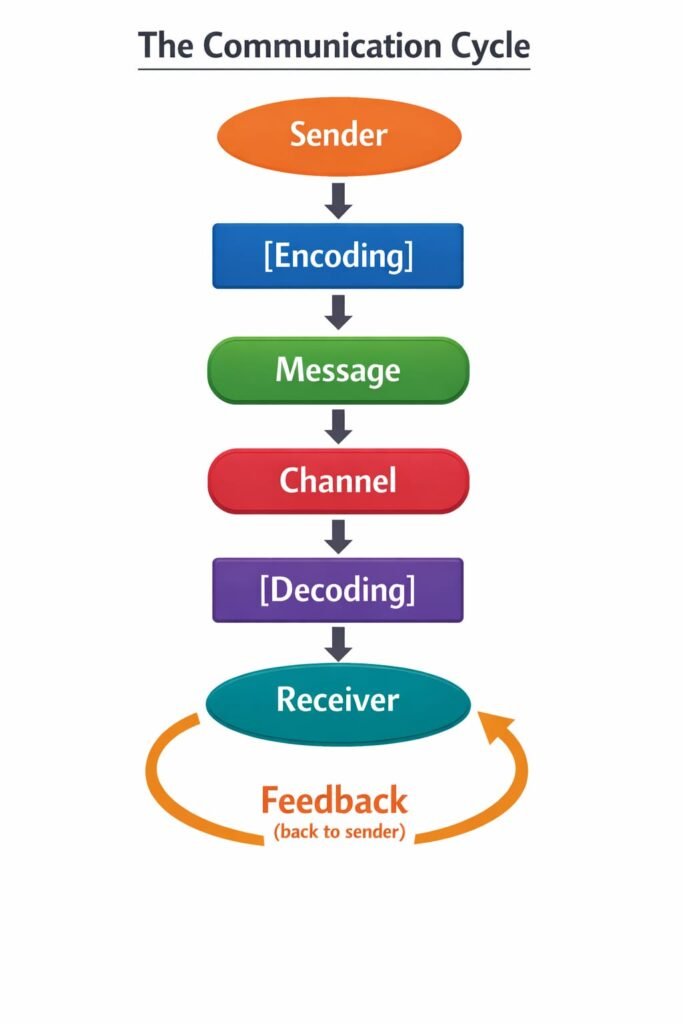
📌 This cycle shows how communication flows between sender and receiver.
Barriers to Communication
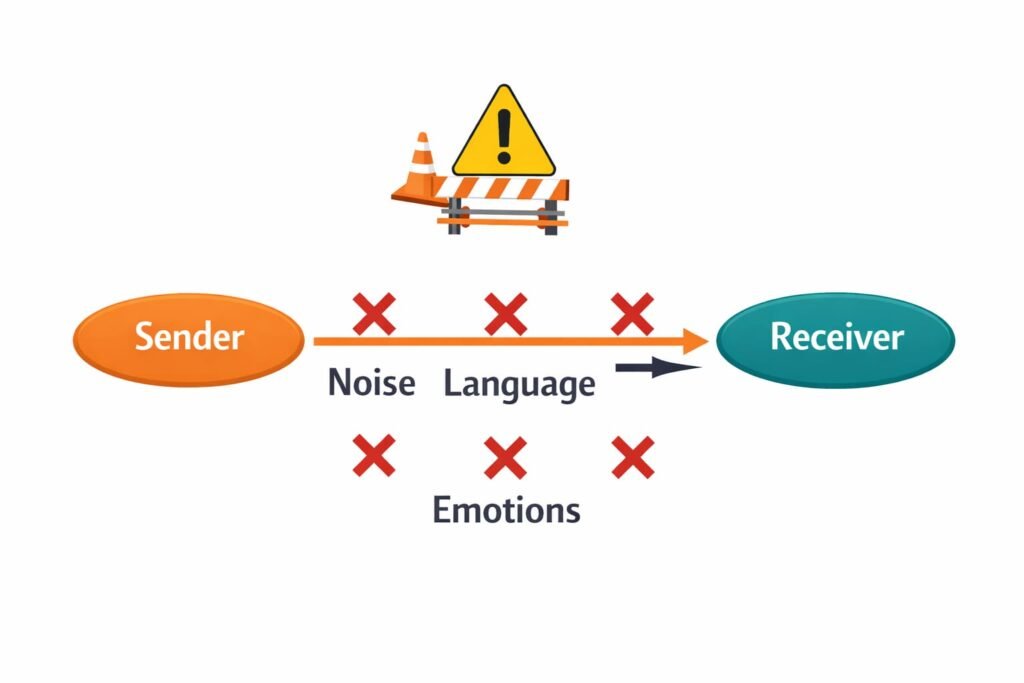
Barriers are obstacles that prevent communication from being effective.
Common Barriers:
- Physical Barriers: Noise, distance
- Language Barriers: Difficult words, different languages
- Emotional Barriers: Stress, anger
- Cultural Barriers: Different beliefs or customs
🚧 Barriers Diagram
Ways to Overcome Barriers
- Use simple and clear language
- Be an active listener
- Maintain eye contact
- Avoid distractions
- Be open-minded and respectful
Communication Skills
1. Listening Skills 👂
- Pay attention
- Do not interrupt
- Show interest
- Give feedback
2. Speaking Skills 🗣️
- Speak clearly
- Use proper tone
- Be confident
- Use correct grammar
3. Reading Skills 📖
- Read carefully
- Understand the meaning
- Improve vocabulary
4. Writing Skills ✍️
- Use proper format
- Avoid spelling mistakes
- Be clear and concise
7 Cs of Communication
- Clear – Message should be easy to understand
- Concise – Short and to the point
- Concrete – Specific and definite
- Correct – Free from errors
- Coherent – Logical flow
- Complete – All information included
- Courteous – Polite and respectful
Importance of Communication Skills
- Helps in better understanding
- Builds confidence
- Improves relationships
- Essential for career growth
- Helps in teamwork
Important Questions & Answers
1 Mark Questions
Q1. What is communication?
👉 Communication is the process of exchanging information between people.
Q2. Name any two types of communication.
👉 Verbal and Non-verbal communication
Q3. What is feedback?
👉 Response given by the receiver
2 Mark Questions
Q1. What are barriers to communication?
👉 Barriers are obstacles that prevent effective communication such as noise, language, or emotions.
Q2. Give two examples of non-verbal communication.
👉 Facial expressions and gestures
3 Mark Questions
Q1. Explain the communication cycle.
👉 The communication cycle includes sender, message, encoding, channel, decoding, receiver, and feedback. It ensures proper understanding of the message.
4 Mark Questions
Q1. Explain the 7 Cs of communication.
👉
- Clear – easy to understand
- Concise – short
- Concrete – specific
- Correct – error-free
- Coherent – logical
- Complete – full information
- Courteous – polite
5 Mark Questions
Q1. Explain types of communication with examples.
👉
- Verbal: Speaking or writing (e.g., conversation)
- Non-verbal: Body language (e.g., smile)
- Visual: Charts and graphs
💡 Exam Tips
- Write answers in points
- Draw diagrams for better marks
- Learn definitions clearly
- Practice Q&A regularly
Conclusion
Good communication skills help students succeed in school and future careers. Practice regularly to improve.
✔️ Now your notes include diagrams + important exam questions for full preparation!