

Advertise in ChatGPT: What Businesses Need to Know About OpenAI Ads
Advertising is entering a new phase.
For years, businesses have competed for attention through Google Search, Meta, YouTube, LinkedIn, and other advertising platforms. But the way people discover products and make purchasing decisions is changing rapidly.
Instead of searching for ten websites, comparing dozens of pages, and reading multiple reviews, people can now ask an AI assistant what they should buy, which solution is best for their situation, or which products fit their requirements.
That shift creates an entirely new advertising opportunity.
OpenAI now offers businesses the ability to advertise inside ChatGPT through OpenAI Ads.
Businesses can learn more and start the advertising process through the official OpenAI Ads platform.
As of September 2026, ChatGPT Ads have expanded significantly beyond the initial U.S. pilot. OpenAI says ChatGPT Ads have reached a $1 billion annualized revenue run rate, are used by tens of thousands of advertisers, and are available across more than 40 countries. Self-service Ads Manager access is also expanding across markets including India, Europe, the Middle East and North Africa. (OpenAI)
So, what exactly are ChatGPT Ads?
How do they work?
How much do they cost?
Who can advertise?
What targeting options are available?
And, most importantly, is advertising on ChatGPT worth considering for your business?
Let’s break it all down.
What Is ChatGPT Advertising?
ChatGPT Ads is OpenAI’s advertising platform that allows businesses to promote products and services within the ChatGPT experience.
The key difference from traditional search advertising is the environment in which the advertisement appears.
Google users typically type keywords such as:
“best laptop under $1,000”
A ChatGPT user might instead have a conversation like:
“I’m a college student studying computer science. I need a lightweight laptop with good battery life, 16GB RAM and enough performance for programming. What should I consider?”
The second interaction contains much more context.
OpenAI describes this as an opportunity to reach people while they are exploring options, comparing alternatives, evaluating trade-offs and making decisions. (OpenAI Ads)
That is the fundamental idea behind AI-native advertising.
Instead of targeting only a keyword, advertisers can potentially reach people based on the context and intent of their conversation.
Where Can You Advertise in ChatGPT?
Businesses can access OpenAI’s advertising platform through:
OpenAI’s current advertising website provides access to Ads Manager, where advertisers can create accounts, campaigns, ad groups and advertisements. (OpenAI Ads)
The platform is designed to support both businesses managing campaigns themselves and larger advertisers that may want sales support.
OpenAI says the fastest way to get started is creating an Ads Manager account, while larger advertisers can request sales support. (OpenAI Ads)
Why Advertise on ChatGPT?
The biggest reason is simple:
People use ChatGPT to make decisions.
ChatGPT isn’t only being used as a question-and-answer tool.
People increasingly use it to:
- Research products
- Compare products
- Find software
- Plan trips
- Choose services
- Learn about brands
- Evaluate alternatives
- Solve business problems
- Research purchases
- Explore ideas
- Decide what to do next
This makes ChatGPT an interesting advertising environment because advertising can potentially appear during the decision-making journey.
OpenAI describes this as reaching users “in the moments that matter.” (OpenAI Ads)
How Do ChatGPT Ads Work?
The basic workflow is straightforward.
According to OpenAI, advertisers can:
Step 1: Create a campaign
You define your:
- Campaign
- Advertising objective
- Budget
- Schedule
- Target countries
- Optional platforms
- Optional custom audiences
Campaigns are the top-level structure for organizing advertising activity. (OpenAI Help Center)
Step 2: Create ad groups
Ad groups help organize advertisements around particular offerings, audiences or contexts.
Advertisers can also provide context hints describing conversations, topics or keywords where their product may be relevant.
Importantly, OpenAI says these are not traditional exact-match keywords and do not guarantee that an ad will appear in a particular conversation. (OpenAI Help Center)
Step 3: Create advertisements
You can provide elements such as:
- Advertiser name
- Headline
- Description
- Image/creative
- Landing page
OpenAI’s advertising documentation recommends creating multiple variations rather than relying on a single message. (OpenAI Help Center)
Step 4: Launch
Once your campaign is configured and approved, you can launch it.
Step 5: Measure and optimize
Ads Manager provides reporting and measurement capabilities that allow advertisers to evaluate performance and optimize campaigns. (OpenAI Ads)
Where Do ChatGPT Ads Appear?
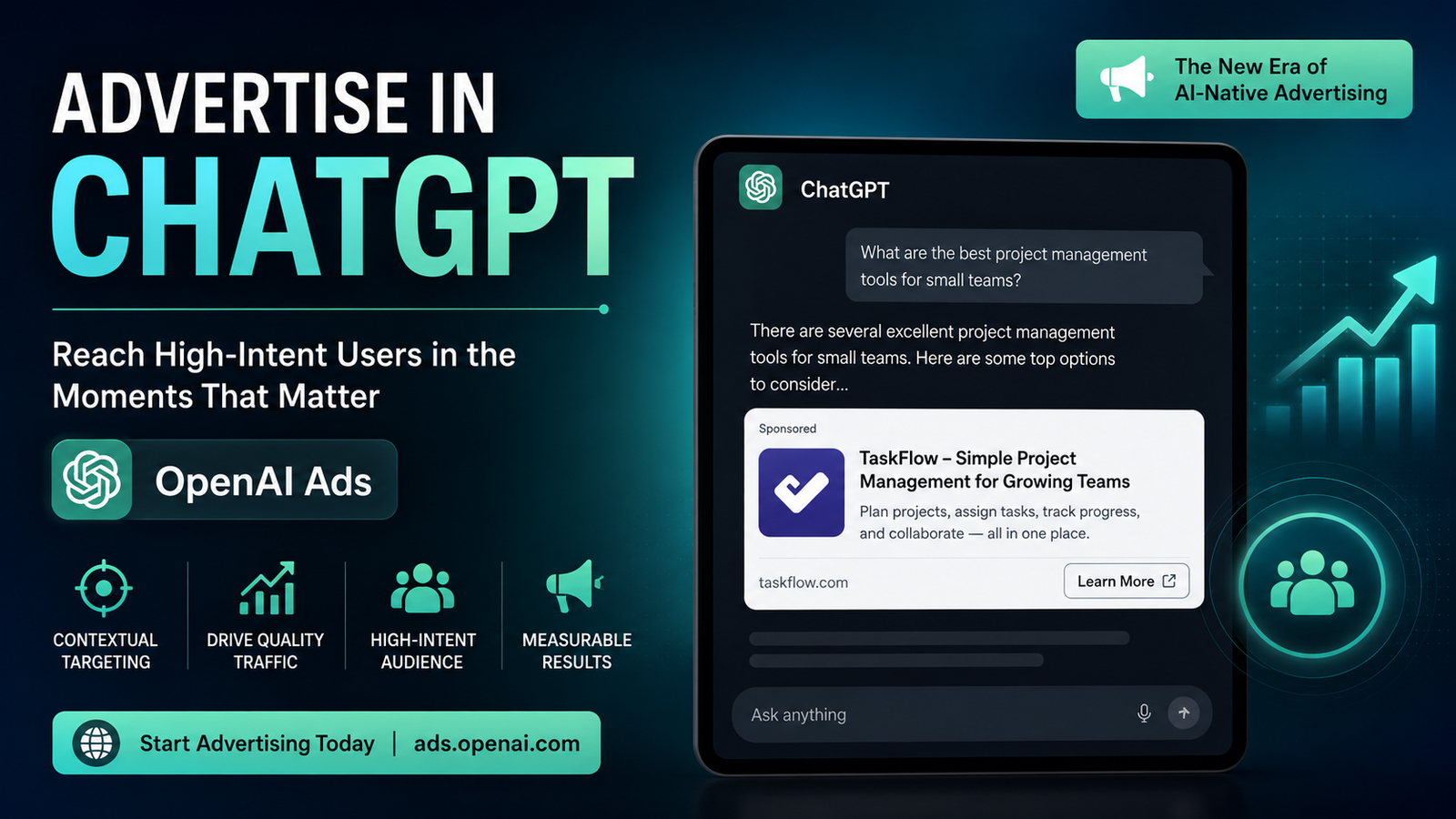
According to OpenAI’s current advertising documentation, ads appear below ChatGPT responses.
An ad unit can include:
- Advertiser name
- Advertiser logo/favicon
- Headline
- Description
- Landing page
- Image creative
This is an important distinction.
Ads are not the same thing as ChatGPT’s answer.
OpenAI says advertisements are clearly identified and remain separate from ChatGPT responses. (OpenAI Ads)
This separation is important because users need to understand which content comes from ChatGPT and which content is paid advertising.
Does Advertising Influence ChatGPT’s Answers?
According to OpenAI, no.
OpenAI explicitly states that advertisements do not influence the answers ChatGPT provides.
The company’s advertising principles emphasize that:
ChatGPT’s answers remain independent and unbiased.
Advertisers also do not receive access to people’s private conversations. (OpenAI)
This is one of the most important differences between an AI advertising platform and the traditional concept of sponsored search results.
How Are ChatGPT Ads Targeted?
This is where ChatGPT Ads becomes particularly interesting.
Traditional advertising platforms often rely heavily on:
- Keywords
- Demographics
- Interests
- Search behavior
- Website activity
ChatGPT advertising introduces another signal:
Conversational context.
OpenAI says its ad system can consider multiple relevance signals, including:
- Current conversation context
- User intent
- Advertisement landing page
- Ad title
- Ad copy
- Advertiser-provided context hints
- Select signals from a user’s broader ChatGPT experience when ads personalization is enabled
This means advertisers aren’t necessarily thinking only:
“What keyword should I bid on?”
Instead, they need to think:
“In what situations would my product genuinely help someone?”
That’s a major change in advertising strategy.
ChatGPT Ads vs Google Search Ads
A useful way to understand ChatGPT advertising is to compare it with traditional search advertising.
| Google-style search advertising | ChatGPT advertising |
|---|---|
| Keyword-driven | Conversation/context-driven |
| User enters a query | User has a conversation |
| Often short queries | Potentially detailed context |
| Keyword intent | Conversational intent |
| Search results environment | AI conversation environment |
| Ads compete around search terms | Ads compete based on relevance and outcomes |
| Landing-page click is often central | Clicks and downstream conversions can be measured |
This doesn’t mean ChatGPT Ads replaces Google Ads.
Instead, it represents a new advertising environment.
What Advertising Objectives Are Available?
OpenAI’s current Ads Manager documentation describes three major campaign objectives:
1. CPM — Reach
CPM means cost per thousand impressions.
This objective is designed primarily for:
- Brand awareness
- Reach
- Visibility
- Large-scale exposure
You pay based on impressions.
2. CPC — Clicks
CPC means cost per click.
This objective focuses on driving traffic and engagement.
Advertisers pay for valid clicks.
OpenAI’s current documentation recommends starting with a maximum CPC bid of $3–$5 USD per click, although actual costs and competitiveness can vary. (OpenAI Help Center)
3. oCPC — Conversion Optimization
OpenAI also supports conversion-optimized CPC, or oCPC.
This is designed for advertisers who care about what happens after the click.
For example:
ChatGPT conversation → Ad click → Website → Purchase
rather than simply:
ChatGPT conversation → Ad click
This can make the platform more interesting for performance marketers.
OpenAI’s campaign documentation currently lists CPM, CPC and oCPC objectives. (OpenAI Help Center)
How Much Does It Cost to Advertise on ChatGPT?
There isn’t one universal “ChatGPT Ads price.”
Costs depend on factors such as:
- Campaign objective
- Competition
- Bid
- Audience/context
- Market
- Campaign performance
- Ad relevance
- Delivery
OpenAI currently supports both CPM and CPC buying options, along with conversion-optimized CPC campaigns. (OpenAI Help Center)
For CPC campaigns, advertisers set a maximum CPC bid.
OpenAI currently recommends a starting maximum CPC of approximately $3–$5 per click. However, this should not be interpreted as a guaranteed price.
Your actual campaign economics can be different.
Does OpenAI Give New Advertisers Any Credit?
Yes.
The current OpenAI Ads website is promoting an introductory offer:
Spend $500 and receive $500 in ad credit.
The offer is displayed directly on the OpenAI Ads homepage. Advertisers should check the current terms and eligibility within Ads Manager before relying on the promotion. (OpenAI Ads)
This can make testing the platform more attractive for eligible businesses.
What Metrics Can You Track?
Advertising is only useful if you can measure results.
OpenAI’s current Ads Manager reporting includes metrics such as:
- Impressions
- Clicks
- Spend
- Click-through rate (CTR)
- Average CPC
- Average CPM
- Conversions
Advertisers can also use:
UTM parameters
Adding UTM parameters to landing-page URLs allows businesses to track ChatGPT traffic inside existing analytics platforms.
For example:
utm_source=chatgpt
This can help distinguish ChatGPT-generated traffic from other channels.
Conversion Tracking
For businesses focused on sales and leads, conversion tracking becomes especially important.
OpenAI provides conversion measurement options through Ads Manager.
The platform has also introduced technologies such as:
- OpenAI Pixel
- Conversions API
- Third-party measurement integrations
These capabilities are designed to help advertisers understand what happens after someone clicks an advertisement. (OpenAI)
This is particularly valuable for:
- Ecommerce
- SaaS
- Lead generation
- Online education
- Digital products
- Services
Can You Target Specific Countries?
Yes.
Campaign setup currently includes country targeting.
OpenAI has also introduced geographic targeting capabilities as the advertising platform has expanded. (OpenAI)
This is particularly important for businesses operating internationally.
For example, a company could potentially create separate campaigns for:
- India
- United States
- United Kingdom
- Germany
- UAE
- Australia
This allows businesses to adjust:
- Messaging
- Landing pages
- Offers
- Budgets
- Creative
- Product availability
for different markets.
Can You Target Audiences?
OpenAI has introduced custom audience capabilities.
Campaigns can include or exclude custom audiences where available. (OpenAI Help Center)
This brings ChatGPT advertising closer to the audience-management capabilities marketers already expect from mature advertising platforms.
However, targeting on ChatGPT should not be thought of simply as “upload a huge customer list and target people.”
The broader philosophy is still about relevance and user context.
What Makes a Good ChatGPT Advertisement?
This is one of the most important parts.
ChatGPT Ads aren’t necessarily a place for traditional “BUY NOW!!!” advertising.
The ad needs to make sense in a conversational environment.
OpenAI recommends:
Be clear.
Users should immediately understand what you offer.
Focus on benefits.
Explain how the product helps.
Be specific.
Avoid vague claims such as:
“The world’s best solution.”
Instead:
“Automate monthly expense reports in minutes.”
Provide useful information.
The ad should feel relevant to the user’s current goal.
Create multiple variations.
OpenAI recommends building diverse ad variations so the system has more opportunities to identify relevant situations. (OpenAI Help Center)
Example: Traditional Ad vs ChatGPT-Native Ad
Imagine you’re selling project management software.
Traditional ad:
THE #1 PROJECT MANAGEMENT SOFTWARE
Transform your business today!
Get Started Now
It’s generic.
Now consider:
ChatGPT-native ad:
Project management for growing teams
Bring tasks, deadlines and team updates into one workspace—without complicated setup.
The second version provides more context.
It’s easier for a user to understand:
- What the product is
- Who it is for
- What problem it solves
That is much closer to OpenAI’s recommended approach. (OpenAI Help Center)
Why Context Matters So Much
Imagine someone asks ChatGPT:
“I’m opening a small restaurant and need a website that I can launch quickly.”
An advertising system based purely on broad demographics may know very little.
But the conversation itself contains valuable context:
Business type: Restaurant
Need: Website
Stage: New business
Intent: High
Potential purchase: Soon
That is why conversational advertising could be powerful.
The advertisement doesn’t necessarily need to interrupt the user.
It can appear when a relevant commercial need is already being discussed.
Which Businesses Could Benefit From ChatGPT Ads?
ChatGPT Ads may be particularly interesting for businesses where people spend time researching before making decisions.
Examples include:
Ecommerce
- Electronics
- Furniture
- Home products
- Fashion
- Consumer products
- Accessories
Software
- SaaS
- Productivity tools
- Business software
- Developer tools
- Marketing software
Education
- Online courses
- Professional training
- Certification programs
- Learning platforms
Travel
- Hotels
- Travel services
- Experiences
- Destinations
Local businesses
- Home services
- Local retailers
- Professional services
OpenAI’s advertising program currently focuses primarily on consumer categories such as lifestyle and household goods, local services, travel and experiences, and digital products or education, with some additional regulated categories subject to approval and rollout restrictions. (OpenAI)
Who Should NOT Rush Into ChatGPT Advertising?
Not every business should immediately spend money on the platform.
You should be cautious if:
- Your website doesn’t convert
- Your offer isn’t clear
- Your landing page is slow
- You don’t have conversion tracking
- Your product has very low margins
- Your audience rarely researches before purchasing
- You cannot afford testing
- You don’t have enough creative variations
- Your product falls into restricted advertising categories
Advertising amplifies your funnel.
If the funnel is broken, advertising usually makes the problem more expensive.
ChatGPT Ads for Small Businesses
One of the most interesting developments is the increasing accessibility of Ads Manager.
OpenAI says its Ads Manager expansion is designed to make ChatGPT advertising more accessible to SMBs and startups, rather than limiting participation to large advertisers. (OpenAI)
For a small business, the strategy should be simple:
Start small.
Don’t immediately allocate a huge budget.
Instead:
- Define one product.
- Define one customer problem.
- Create several ad variations.
- Build a strong landing page.
- Set up tracking.
- Start with a controlled budget.
- Measure clicks and conversions.
- Identify winning messages.
- Scale gradually.
A Practical ChatGPT Ads Strategy
Here’s a simple framework I would recommend.
Step 1: Choose one high-value product
Don’t advertise everything simultaneously.
Pick the product with:
- Strong margins
- Proven demand
- Good reviews
- Clear differentiation
- Strong conversion rate
Step 2: Identify conversational intent
Ask:
“What would someone say to ChatGPT immediately before they need my product?”
For example, if you sell accounting software:
Potential conversations might include:
- “What’s the easiest accounting software for a small business?”
- “How do I track expenses?”
- “I need to automate invoices.”
- “What accounting software should I use for my startup?”
These situations represent potential commercial intent.
Step 3: Create Multiple Ad Angles
Don’t write 20 versions that say exactly the same thing.
Instead, create different angles.
Angle 1 — Problem
Stop managing invoices manually.
Angle 2 — Benefit
Automate invoices and get paid faster.
Angle 3 — Audience
Simple accounting software for small businesses.
Angle 4 — Feature
Create invoices, track expenses and manage payments in one place.
Angle 5 — Ease
Set up your business accounting without complicated software.
Different messages can work better in different conversational contexts.
Step 4: Build a Strong Landing Page
Getting the click is only half the battle.
Your landing page should answer:
What is this?
Who is it for?
Why should I care?
Why should I trust you?
What should I do next?
The message between the advertisement and landing page should also be consistent.
If your ad promises:
“Accounting software for freelancers”
but the landing page says:
“Enterprise financial management platform”
you’ve created friction.
Step 5: Track Conversions
Don’t optimize only for clicks.
Track meaningful business outcomes such as:
- Purchases
- Signups
- Demo requests
- Leads
- Trial registrations
- Subscription starts
A campaign with a lower CTR can sometimes be more valuable than one with a high CTR if it generates significantly better customers.
Step 6: Optimize Based on Business Results
Think beyond:
How many people clicked?
Ask:
How many became customers?
A simple calculation is:
Customer Acquisition Cost (CAC)
CAC = Advertising Spend ÷ New Customers
For example:
If you spend $1,000 and acquire 20 customers:
$1,000 ÷ 20 = $50 CAC
Then compare that against your customer economics.
If your average gross profit per customer is $200, a $50 acquisition cost could potentially be attractive.
If your profit is only $30, the same campaign may not make economic sense.
ChatGPT Ads and AI Search Optimization Are Different
This is an important distinction.
Many businesses are currently talking about:
GEO — Generative Engine Optimization
or optimizing content so AI systems can discover and reference their businesses.
That’s different from advertising.
Organic AI visibility
You try to become useful and discoverable through content and reputation.
ChatGPT Ads
You pay to promote your business through the advertising platform.
The two strategies can complement each other.
A smart business could potentially work on both:
Organic AI visibility + paid ChatGPT advertising
Privacy: What Do Advertisers See?
Privacy is one of the biggest questions surrounding AI advertising.
OpenAI states that advertisers do not receive access to people’s private conversations. (OpenAI)
OpenAI also says users retain control over how their data is used for advertising personalization. (OpenAI Ads)
This means advertisers shouldn’t think of ChatGPT Ads as receiving a transcript of a user’s private conversation.
Instead, the advertising system uses signals to determine relevance and deliver advertisements.
Brand Safety
Brand safety is another major part of the platform.
OpenAI says advertisements are designed to appear only alongside chats that are considered appropriate and consistent with user trust.
Ads are restricted from sensitive and unsafe contexts, including categories such as:
- Child safety
- Cyber abuse
- Fraud
- Graphic violence
- Hate
- Terrorism
- Weapons
- Political content
- Self-harm
- Certain regulated goods
- Sensitive personal and health contexts
(OpenAI)
This is important for advertisers because the environment in which an ad appears can affect brand perception.
What Businesses Need Before Starting
Before creating your first ChatGPT campaign, prepare these assets.
Business essentials
- Company name
- Website
- Business information
- Advertising markets
- Payment method
- Campaign budget
Marketing assets
- Product/service description
- Multiple headlines
- Multiple ad descriptions
- Images/creative
- Landing page
- CTA
Measurement
- Analytics
- UTM tracking
- Conversion tracking
- Pixel/measurement setup where appropriate
A Simple First Campaign Structure
For example, imagine you’re advertising a productivity SaaS.
Campaign
Goal: Conversions
Ad Group 1
Theme: Productivity
Ad Group 2
Theme: Team collaboration
Ad Group 3
Theme: Project management
Within each ad group:
- 5–10 headline variations
- Multiple descriptions
- Relevant landing page
- Relevant context hints
Then allow performance data to determine which combinations deserve more investment.
Common Mistakes to Avoid
1. Treating ChatGPT like Google
Don’t simply copy your Google Ads strategy.
ChatGPT is conversational.
Your messaging should reflect that.
2. Using generic marketing language
Avoid:
“Revolutionary. Innovative. World-class.”
Tell users what the product actually does.
3. Using only one advertisement
More diverse creative gives the system more opportunities to match your offering to relevant situations. (OpenAI Help Center)
4. Optimizing only for clicks
Clicks aren’t customers.
Measure conversions.
5. Sending everyone to the homepage
Create dedicated landing pages where possible.
6. Ignoring the conversation context
The unique advantage of ChatGPT advertising is contextual relevance.
Use it.
Is ChatGPT Advertising Worth It?
For some businesses, absolutely.
But it’s still a relatively young advertising platform.
The opportunity is compelling because ChatGPT sits directly inside a workflow where users:
Ask → Explore → Compare → Decide → Act
Traditional advertising often tries to capture attention.
ChatGPT advertising has the potential to appear closer to the decision-making moment.
That makes the platform particularly interesting for businesses selling products or services that require research and consideration.
OpenAI reports that tens of thousands of advertisers are already using ChatGPT Ads and that the platform reached a $1 billion annualized revenue run rate in less than 200 days after launch. (OpenAI)
At the same time, advertisers should remember that performance varies by business, market, offer and campaign execution.
There is no guarantee that ChatGPT Ads will outperform Google, Meta, LinkedIn or other channels for every company.
How to Start Advertising in ChatGPT
The easiest place to begin is the official OpenAI Ads platform:
According to OpenAI, the process is:
Create an account → Create a campaign → Add ad details → Launch → Measure → Optimize. (OpenAI Ads)
OpenAI also provides a dedicated ChatGPT Ads Help Center containing documentation for Ads Manager, campaign setup, account setup, conversion optimization, product feeds and other advertising features. (OpenAI Help Center)
Frequently Asked Questions
Is ChatGPT advertising available now?
Yes. ChatGPT Ads have moved beyond the original U.S. pilot and are expanding globally. OpenAI says the platform is available in more than 40 countries, with self-service Ads Manager expanding into additional regions including India. (OpenAI)
How do I advertise on ChatGPT?
Visit:
Create an Ads Manager account and set up your campaign.
How much does ChatGPT advertising cost?
OpenAI currently supports CPM, CPC and conversion-optimized CPC buying models. CPC campaigns have a recommended starting maximum bid of approximately $3–$5 per click, but actual costs vary. (OpenAI Help Center)
Can small businesses advertise?
Yes. OpenAI has expanded Ads Manager specifically to make the platform more accessible to small and medium-sized businesses and startups. (OpenAI)
Can I advertise in India?
OpenAI announced self-service ChatGPT Ads expansion into India in August 2026. Availability and eligibility should be confirmed inside the current Ads Manager experience. (OpenAI)
Do advertisers get access to ChatGPT conversations?
No. OpenAI states that advertisers do not receive access to people’s private conversations. (OpenAI)
Do ads change ChatGPT’s answers?
According to OpenAI, advertisements do not influence ChatGPT’s answers. Ads are clearly labeled and separate from responses. (OpenAI Ads)
Can I measure conversions?
Yes. OpenAI provides conversion measurement and reporting capabilities, with support for tools such as the OpenAI Pixel and Conversions API. (OpenAI)
Final Thoughts
ChatGPT advertising represents something bigger than simply adding another advertising platform to a marketer’s toolbox.
It represents a shift from:
Search advertising
to
Conversational advertising.
The difference is subtle but important.
When someone searches:
“Best running shoes”
they provide a keyword.
When someone tells ChatGPT:
“I’m training for my first half marathon, I run four times a week, I have mild overpronation and need shoes that can handle long-distance training”
they provide context.
That context can potentially make advertising more relevant.
For marketers, this creates a new question.
Instead of asking:
“What keywords should I target?”
we may increasingly need to ask:
“What conversations happen immediately before someone needs what I sell?”
That could become one of the most important questions in AI-era marketing.
And for businesses that want to experiment early, the starting point is simple:
Advertise in ChatGPT with OpenAI Ads
Start small. Measure everything. Test different messages. Focus on usefulness. And optimize for real business outcomes—not just impressions and clicks.