
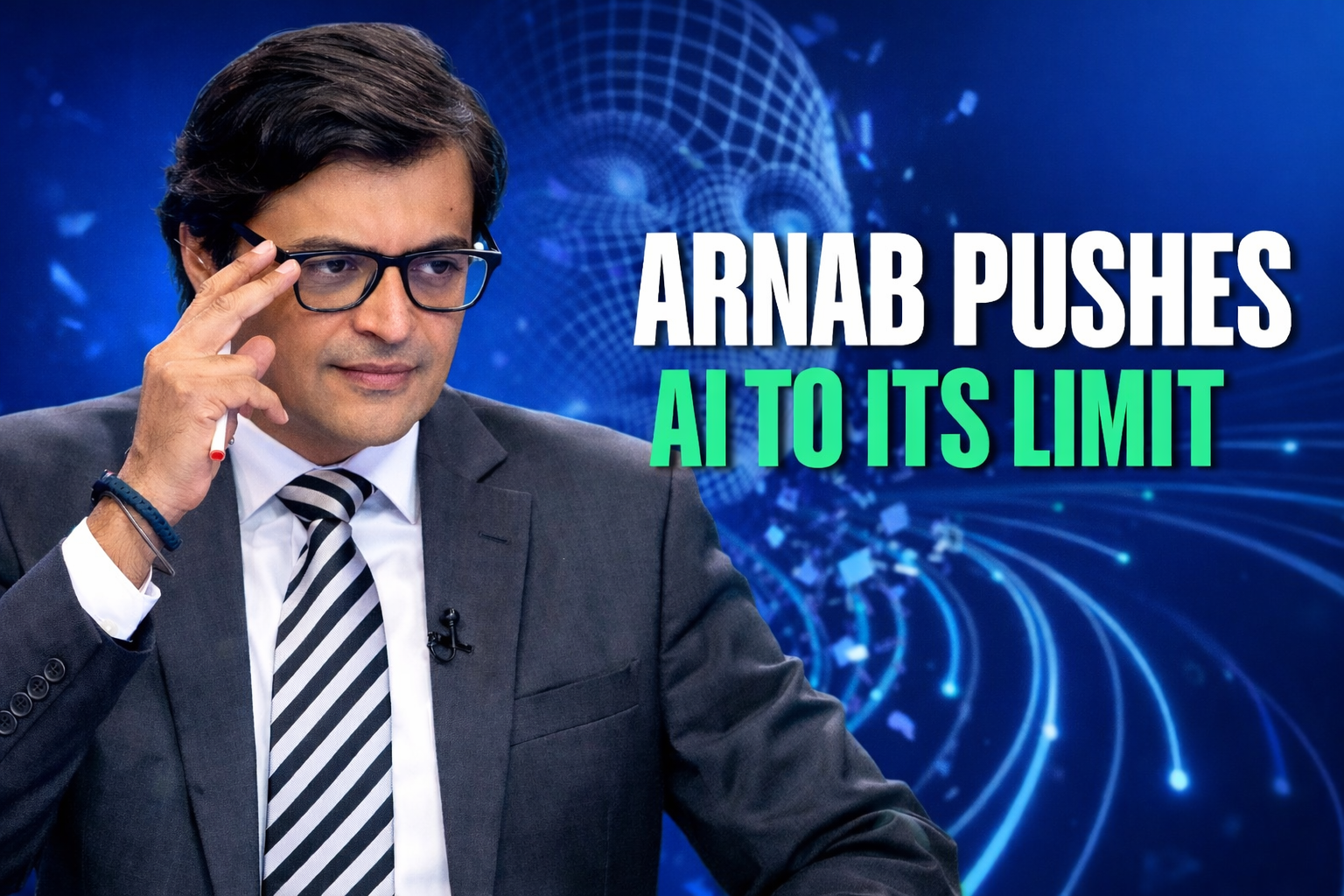
A Historic Moment in Indian Television
Blue Machines, an Indian AI company, just made history by doing something no one had ever done before – they brought a Voice AI system onto one of India’s most-watched primetime TV shows and let it face off against Arnab Goswami, one of the country’s most intense and aggressive journalists. This wasn’t just a tech demo; it was a full-blown interrogation that exposed both the impressive capabilities and fundamental limitations of AI.
What Actually Happened?
Imagine this: Arnab Goswami, known for his rapid-fire questioning style and interrupting politicians mid-sentence, sitting across from an AI. Not a chatbot you type to, but a Voice AI that speaks and responds in real-time. Blue Machines brought their AI technology to face the ultimate stress test – a live primetime debate with someone who doesn’t hold back.
The segment wasn’t gentle. Arnab did what he does best – he pushed, he questioned, he interrupted, and he challenged the AI on everything from its capabilities to its very existence and personality.
Why This is a World Record
Let’s break down why this matters:
1. First Time on Indian Primetime TV No Indian company had ever demonstrated advanced Voice AI technology on a major primetime news show before. This wasn’t a controlled tech conference or a friendly podcast – this was live television with millions watching.
2. Real-Time Interaction The AI had to respond instantly to Arnab’s questions, just like a human guest would. There was no typing, no delays, no editing. It was raw, live conversation.
3. Hostile Environment Test Most AI demos happen in friendly settings. Blue Machines chose possibly the most challenging environment possible – facing a journalist famous for aggressive questioning.
The Big Questions: What Arnab Asked
Arnab didn’t go easy on the AI. He asked the kinds of questions that get to the heart of what AI really is:
About AI’s Limitations
“What can’t you do?” – Arnab pushed the AI to admit its weaknesses. This is important because many AI companies only talk about what their technology can do, not what it cannot.
“Where do you fail?” – He wanted specific examples of failure, not marketing language.
“Are you replacing humans?” – The big fear everyone has about AI – will it take our jobs, our creativity, our humanity?
About AI’s Personality
Here’s where it got really interesting. Arnab questioned whether AI even has a personality:
“Who are you really?” – Can a machine have an identity?
“Do you have feelings?” – This goes to the core of what separates humans from machines.
“Are you conscious?” – Perhaps the deepest philosophical question about AI.
“Can you be creative or are you just copying?” – Does AI create or just remix what humans have made?
How the AI Responded
From what we understand, the AI didn’t try to pretend to be human. This is crucial. Instead, it:
- Acknowledged its limitations honestly – Admitting that it doesn’t have real emotions, consciousness, or independent thought
- Explained what it actually is – A tool created by humans, trained on human knowledge
- Clarified its role – To assist humans, not replace them
- Was transparent about its nature – It’s a language model that processes patterns, not a thinking being
Why Arnab “Won”
The headline says “Arnab Wins AI” – but what does that mean?
Arnab won because he exposed the truth: No matter how impressive AI sounds, it’s still a tool. It doesn’t have:
- Real consciousness
- Genuine emotions
- Original thoughts
- True understanding
- A personality in the human sense
The AI couldn’t:
- Get angry when interrupted (though Arnab surely tried to make it “angry”)
- Have opinions based on personal experience
- Feel pride, shame, or any real emotion
- Claim to be anything more than what it is
This wasn’t a defeat for Blue Machines, though. By having their AI honestly admit these limitations on live TV, they actually showed integrity and transparency – something desperately needed in the AI industry.
What This Means for India’s AI Industry
Blue Machines’ Bold Move
By putting their technology through this trial by fire, Blue Machines showed:
1. Confidence in their product – They believed their Voice AI could handle the pressure
2. Transparency – They weren’t afraid to show limitations publicly
3. Innovation in presentation – Instead of a boring tech demo, they created must-watch TV
4. Indian AI on the global stage – This proved Indian companies can compete in cutting-edge AI technology
The Bigger Picture
This demonstration matters because:
- It demystifies AI – People saw exactly what AI can and cannot do
- It starts important conversations – About AI’s role in society, jobs, creativity
- It shows AI’s current state – Impressive but not magical, useful but not conscious
- It proves Indian innovation – An Indian company creating world-class AI technology
Understanding AI’s Real Limitations (In Simple Terms)
Let’s break down what AI cannot do, based on questions like those Arnab likely asked:
1. No Real Understanding
AI processes words as patterns, not meanings. It’s like someone who can perfectly mimic speaking French without understanding a single word.
2. No True Creativity
AI remixes and recombines what it learned from human-created content. It’s like a very sophisticated copy-paste machine, not an artist with original vision.
3. No Consciousness
When AI says “I think” or “I feel,” these are just language patterns it learned. It has no inner experience, no awareness.
4. No Emotions
AI can recognize emotions in text and respond appropriately, but it doesn’t feel happiness, sadness, anger, or fear.
5. No Common Sense
AI can fail at things a five-year-old would find obvious because it doesn’t experience the physical world.
6. No Accountability
AI can’t take responsibility for its mistakes because it has no moral agency.
The Questions This Raises
This historic confrontation brought up questions we all need to think about:
For Society:
- How much should we rely on AI?
- What jobs should only humans do?
- How do we regulate AI responsibly?
For Individuals:
- Should we trust AI’s advice?
- How do we know when AI is wrong?
- What skills will remain uniquely human?
For India:
- Can India become an AI superpower?
- How do we balance innovation with job protection?
- What role should Indian companies play in global AI development?
What Made This Different from Other AI Demos
Most AI demonstrations are carefully controlled:
- Pre-written questions
- Friendly interviewers
- Edited videos
- Perfect conditions
Blue Machines did the opposite:
- Unpredictable questions
- Aggressive interviewer
- Live broadcast
- High-pressure environment
This is like the difference between practicing cricket in your backyard versus playing in a World Cup final.
The Human Element: Why Arnab’s Approach Mattered
Arnab’s aggressive style actually served a purpose here. By pushing hard, he:
- Prevented PR fluff – The AI couldn’t hide behind marketing language
- Asked what viewers think – His questions reflected common fears and curiosities about AI
- Demanded honesty – There was no room for exaggeration
- Created engagement – Made a tech topic entertaining and accessible
What We Learned
About AI:
- It’s impressive but limited
- It’s a tool, not a being
- It can handle pressure but not consciousness
- It should augment humans, not replace them
About Indian Tech:
- Indian companies can innovate at world-class levels
- There’s appetite for bold demonstrations
- Transparency builds trust more than hype
About Media:
- Technology needs scrutiny, not just celebration
- Aggressive questioning has value
- Live demonstrations reveal truth better than controlled demos
The Future After This Historic Moment
This event opens doors:
For Blue Machines:
- Global recognition
- Credibility through transparency
- A benchmark for honest AI communication
For Indian AI Industry:
- Proof that Indian companies can lead
- A model for responsible AI presentation
- International attention and investment potential
For AI Development Globally:
- A new standard for public AI demonstrations
- Evidence that honesty about limitations builds trust
- A template for how to present AI to non-technical audiences
Final Thoughts: Why This Matters to You
You might wonder: “Why should I care about an AI being questioned on TV?”
Here’s why:
1. AI is coming to your life – Whether in customer service, healthcare, education, or entertainment, you’ll interact with AI soon if you don’t already.
2. You need to know what it can’t do – Understanding AI’s limitations helps you use it wisely and know when to trust it.
3. Indian innovation affects you – If Indian companies lead in AI, it means jobs, economic growth, and technological independence for India.
4. Transparency matters – Companies that are honest about limitations are companies you can trust.
5. The conversation is just beginning – We’re all figuring out how AI fits into human society, and demonstrations like this help us have informed discussions.
Conclusion
“Arnab vs AI” wasn’t just entertainment or a publicity stunt. It was a watershed moment where:
- An Indian company (Blue Machines) showed world-class AI technology
- On primetime television (unprecedented globally)
- Under extreme scrutiny (Arnab’s questioning)
- With complete honesty (admitting limitations)
Arnab “won” by exposing that AI, despite its impressive abilities, is still fundamentally a tool created by humans, limited by human knowledge, and lacking consciousness, emotions, and true understanding.
But in a bigger sense, we all won. We got to see AI as it really is – not the magic portrayed in movies, not the doomsday scenario from headlines, but a powerful technology with both impressive capabilities and important limitations.
Blue Machines won too, by choosing transparency over hype, and by proving that Indian innovation can set world records and lead global conversations about the future of technology.
This is just the beginning. As AI becomes more integrated into our daily lives, we need more moments like this – honest, challenging, and illuminating conversations about what this technology really is and what it means for humanity.
The question now is: What comes next?
Leave a Reply