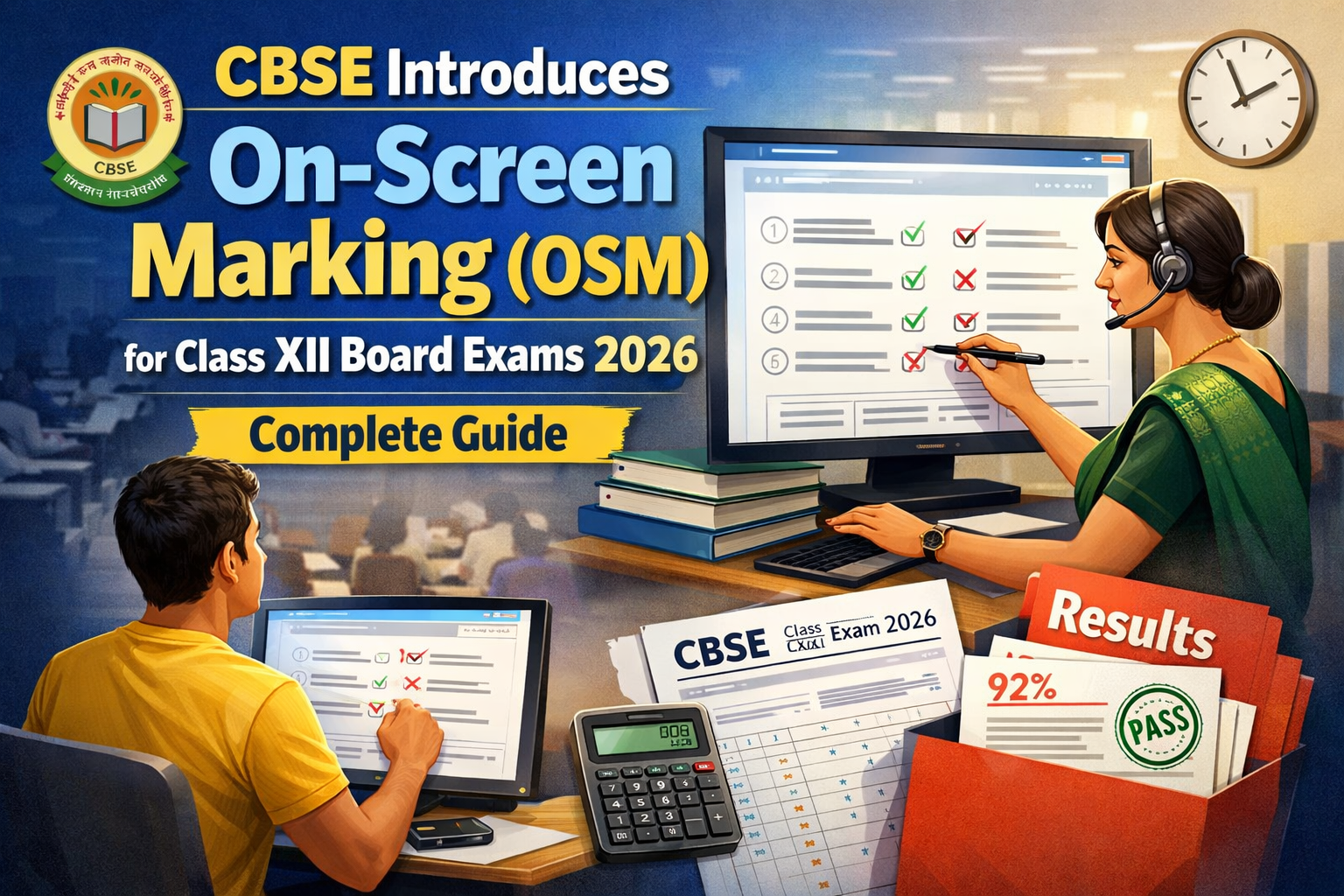
In a major digital transformation initiative, the Central Board of Secondary Education (CBSE) has announced the introduction of On-Screen Marking (OSM) for Class XII examinations starting in 2026. This revolutionary change will impact nearly 46 lakh students appearing for board exams across India and 26 countries worldwide.
What is On-Screen Marking (OSM)?
On-Screen Marking is a digital evaluation system where teachers evaluate answer sheets on computer screens instead of physically marking paper answer books. The answer sheets are scanned and made available digitally to evaluators who can assess them from their own schools without traveling to centralized evaluation centers.
Important Note: For 2026, OSM will only be implemented for Class XII examinations. Class X answer books will continue to be evaluated in physical mode as before.
Key Benefits of On-Screen Marking
CBSE has identified several significant advantages of implementing OSM:
- Elimination of Totaling Errors: Automated calculation of marks removes human errors in addition.
- Reduced Manual Intervention: Automated coordination streamlines the entire evaluation process.
- Faster Evaluation: Digital marking enables quicker processing with participation from more teachers.
- Cost and Time Savings: No transportation required, saving both time and expenses.
- Teacher Convenience: Teachers can evaluate from their own schools while continuing regular duties.
- No Post-Result Verification Needed: Digital records eliminate the need for mark verification after results.
- Reduced Manpower: Less staff required for verification processes.
- Universal Participation: All affiliated schools globally can contribute to evaluation.
- Environmental Sustainability: Digital evaluation reduces paper usage and carbon footprint.
Technical Requirements for Schools
To participate in OSM, schools must ensure the following infrastructure is in place:
Hardware Requirements:
- Computer lab with Public Static IP (as per Affiliation Bye-Laws)
- PC/Laptop with Windows OS 8 or above
- Minimum 4 GB RAM or higher
- At least 1 GB free space on C:/ drive
- Uninterrupted power supply
Software Requirements:
- Latest internet browser (Chrome/Edge/Firefox)
- Adobe Reader (downloadable from https://get.adobe.com/reader)
Internet Connectivity:
- Reliable internet connection with minimum 2 Mbps speed
How Does the OSM System Work?
The digital evaluation system follows a structured hierarchy:
Evaluation Hierarchy:
- Head Examiner (HE): Oversees the entire evaluation process at the center
- Associate Head Examiners (AHE): Supervise groups of evaluators and review their assessments
- Evaluators: Teachers who perform the actual marking of answer books
Step-by-Step Evaluation Process
1. Login Process
- Evaluators receive login credentials from the Evaluation Center In-charge
- Access the system via: https://cbse.onmark.co.in/cbseevalweb
- Login using User ID, Password, and OTP sent to registered mobile/email
2. Main Assessment Features
The OSM platform provides several tools to make evaluation efficient and accurate:
- Zoom In/Out: Adjust page view for better readability by using plus/minus controls
- Page Rotation: Rotate pages by 90 degrees for proper viewing orientation
- Award Marks: Right-click to access marks menu and assign scores to questions
- Mark NA (Not Answered): Designate questions not attempted by students
- Annotations: Use various annotation tools including:
- “Repeat Ans.” for answers written multiple times
- “View” annotation when answer spans multiple pages
- “Blank Page” for pages with no content
3. Quality Assurance Features
- Marks Revision: Easy correction of marks already awarded using the delete function
- Choice-Based Questions: Automatic handling when students attempt more questions than required
- Script Comments: Add comments using the balloon icon for specific observations
- Page Annotation Tracking: Color-coded system (Green for annotated, Red for missing) ensures every page is reviewed
4. Special Cases Handling
- UFM (Unfair Means): Mark answer books showing malpractice with reason and remarks
- Reject Answer Book: Option to reject scripts with proper justification
- Question Paper & Solution Access: View question papers and marking schemes during evaluation
5. Submission Process
- Review all marks before submission
- System displays confirmation window for final review
- Marks are uploaded to server after confirmation
- Next answer book is automatically presented for evaluation
CBSE Support and Training
To ensure smooth implementation, CBSE has committed to providing comprehensive support:
- System Familiarization: All teachers with OASIS IDs can log in and explore the system
- Multiple Dry Runs: Practice sessions before actual evaluation begins
- Training Programmes: Dedicated sessions to explain system functionality
- Call Center Support: Helpline for resolving technical issues
- Instructional Videos: Video tutorials for better understanding
- User Manual: Comprehensive documentation available within the system
Important Points for Teachers
- All teachers must have updated OASIS IDs
- Bank account details must be added in the profile section for remuneration processing
- Evaluators can view evaluation reports and track their progress
- In case of mark variance, AHE revisions will be visible in reports
- Every page must be annotated; missing annotations trigger error messages
Timeline and Implementation
The official circular was issued on February 9, 2026, announcing the implementation for Class XII examinations in 2026. Schools have been requested to ensure all technical requirements are met promptly.
Detailed instructions for each activity will be issued separately by CBSE to ensure all stakeholders can prepare adequately.
Conclusion
The introduction of On-Screen Marking represents a significant leap forward in CBSE’s digital transformation journey. This system promises to make the evaluation process more efficient, transparent, and teacher-friendly while maintaining the highest standards of accuracy and fairness. With proper infrastructure and training, this initiative is set to revolutionize how board examinations are evaluated in India.
Schools and teachers should begin preparations immediately to ensure readiness for the 2026 examinations. For any queries or clarifications, stakeholders can reach out to their respective Regional Directors or contact CBSE directly through official channels.
Reference PDF by CBSE
For more updates on CBSE examinations and educational policies, stay connected with our blog.