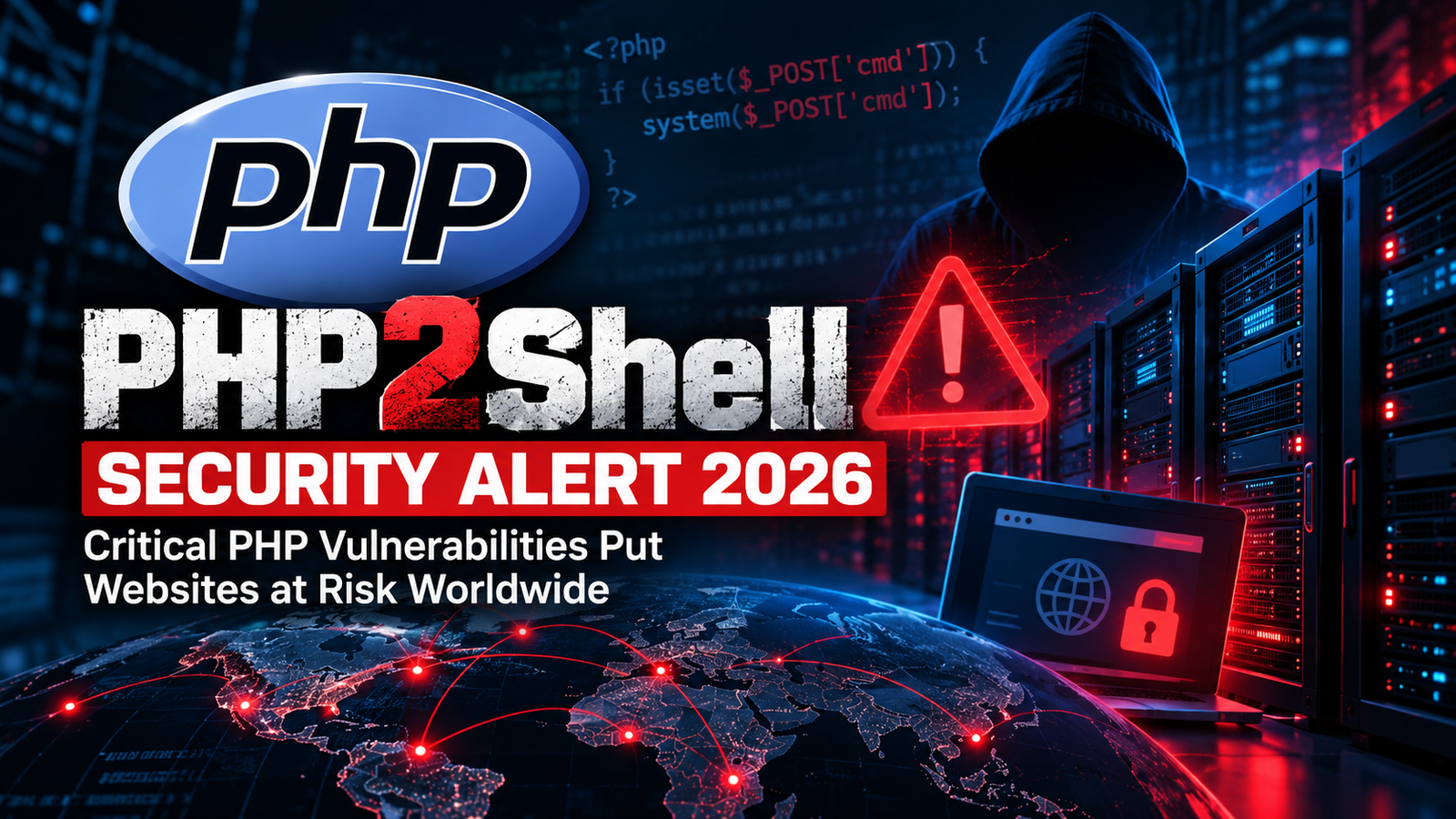
Two critical security vulnerabilities in PHP have triggered urgent warnings from cybersecurity authorities and technology companies worldwide. The vulnerabilities, known as PHP2Shell, could allow attackers to execute unauthorized code on vulnerable web servers, potentially putting websites, applications, and sensitive data at risk.
The PHP security team released patches on October 21, 2026, for two vulnerabilities tracked as CVE-2026-109618 and CVE-2026-109619. Both received a critical severity score of 9.2 out of 10.
The situation has attracted widespread attention because PHP powers a substantial portion of the web, including WordPress websites, online stores, news portals, and custom business applications. Security researchers have also reported attempts to exploit the vulnerabilities, increasing the urgency for administrators to verify their systems.
Hosting company Hostinger has published its own security update explaining the protective measures deployed across its hosting infrastructure and the actions required from VPS customers.
In this report, Itxperts explains what happened, why PHP2Shell matters, which websites may be affected, and what website owners should do now.
What Is PHP2Shell?
PHP2Shell is the name associated with two critical vulnerabilities discovered in the PHP programming language’s request-processing and memory-handling mechanisms.
PHP is a server-side programming language used to build dynamic websites and web applications. It powers popular platforms such as WordPress and WooCommerce, as well as frameworks such as Laravel and Symfony.
The PHP2Shell vulnerabilities are particularly serious because they affect the underlying PHP runtime rather than just a particular website application.
Under certain conditions, an unauthenticated attacker could exploit the vulnerabilities to execute unauthorized code on a vulnerable server. Depending on the server’s configuration and permissions, this could expose sensitive information, compromise an application, or disrupt website operations.
The two original vulnerabilities are:
- CVE-2026-109618: A memory-handling flaw associated with failures during PHP request processing.
- CVE-2026-109619: A memory-management vulnerability involving the use of memory after it has been released.
Both vulnerabilities received a CVSS severity rating of 9.2 out of 10, placing them in the critical category.
According to Hostinger’s official PHP2Shell security announcement, information about the vulnerabilities leaked before the planned release, and exploit code for one of the flaws was already circulating before the security fixes became available. <Cite refs={[“turn596777search0″,”turn596777search1”]}/>
Why Is PHP2Shell Trending Worldwide?
PHP2Shell has become a major cybersecurity concern because the vulnerabilities affect a widely deployed technology and can potentially be exploited remotely.
Several developments have contributed to the urgency.
1. Critical vulnerabilities in PHP itself
Unlike a vulnerability limited to one plugin or website, a flaw in the PHP runtime can affect many different applications running on vulnerable installations.
Websites may remain exposed even if their application code is well maintained.
2. Public disclosure and exploit development
Information about the vulnerabilities became public before the planned release of the fixes. Security reporting subsequently described exploit attempts and the development of proof-of-concept code.
This created a narrow window in which administrators needed to assess their exposure and apply security updates.
3. Warnings from cybersecurity authorities
Cybersecurity organizations have issued urgent guidance recommending that affected systems be identified and patched promptly.
The Canadian Centre for Cyber Security, for example, warned that internet-facing PHP servers and applications face elevated risk and recommended immediate updates. <Cite refs={[“turn596777search2″,”turn596777news12”]}/>
4. The widespread use of PHP
PHP is used across blogs, business websites, content management systems, online stores, and enterprise applications.
As a result, the vulnerabilities have implications for businesses of different sizes, from small websites hosted on shared servers to large organizations operating their own infrastructure.
Important: The vulnerabilities create a widespread security risk, but that does not mean every PHP website has been compromised. The actual risk depends on the software version, configuration, and protections in place.
Which PHP Versions Are Affected?
The PHP security team released fixes for the original PHP2Shell vulnerabilities on October 21, 2026.
The patched releases are:
| PHP Branch | Patched Version |
|---|---|
| PHP 8.5 | 8.5.12 |
| PHP 8.4 | 8.4.27 |
| PHP 8.3 | 8.3.36 |
| PHP 8.2 | 8.2.35 |
Versions older than the corresponding patched release in these branches are affected by the original vulnerabilities. Older and unsupported PHP branches may also be vulnerable and require vendor-specific guidance or an upgrade.
These version numbers relate to the original PHP2Shell fixes. They should not be interpreted as proof that a server is protected against every later PHP vulnerability.
For the latest information, consult the official PHP website and your operating system or hosting provider’s security announcements.
Does PHP2Shell Affect WordPress Websites?
Yes. WordPress is built on PHP, so a WordPress website can be affected if its underlying PHP runtime is vulnerable.
The same concern applies to other PHP-based applications, including:
- WooCommerce online stores.
- Laravel web applications.
- Magento e-commerce websites.
- Joomla websites.
- Drupal websites.
- Custom PHP websites and business portals.
The key distinction is that PHP2Shell affects the PHP runtime itself.
Updating WordPress core, themes, and plugins remains important, but those updates do not independently repair the underlying PHP vulnerabilities.
Website owners should therefore check both their application updates and the security status of their PHP environment.
Can PHP2Shell Allow Attackers to Take Over a Website?
Under the conditions required for successful exploitation, the original vulnerabilities could allow an attacker to execute unauthorized code on a vulnerable server.
The possible consequences depend on the privileges of the affected process and the server’s security configuration.
Potential impacts include:
Unauthorized code execution: An attacker may be able to run code with the permissions available to the affected PHP process.
Exposure of sensitive data: Information accessible to the compromised application or process could be put at risk.
Website disruption: Exploitation may cause application failures, service interruptions, or other availability problems.
Further compromise: If the PHP process has excessive permissions or access to other systems, the consequences could extend beyond the original application.
These are potential outcomes of successful exploitation, not evidence that every vulnerable website has experienced these incidents.
Hostinger’s Response to the PHP2Shell Vulnerabilities
Hostinger published a security announcement on October 21, 2026, explaining how it was responding to PHP2Shell.
According to the company, its response included:
- Adding firewall rules to block known exploit patterns.
- Rejecting certain malformed upload requests.
- Disabling session upload progress in specified hosting configurations as an additional mitigation.
- Deploying the relevant PHP security updates across its managed hosting infrastructure.
- Continuing to monitor traffic and adjust protections as necessary.
Hostinger’s announcement distinguishes between managed hosting and VPS services.
What Hostinger customers need to know
Managed Web, Cloud, Agency, and cPanel hosting: Hostinger states that it manages PHP security updates on these plans and that customers do not need to apply a separate manual PHP2Shell fix. Customers should consult the provider’s latest status information for confirmation.
Hostinger VPS: Customers who manage their own PHP installation must apply the relevant updates and restart the affected PHP workers or services. Hostinger’s managed server protections should not be assumed to cover a self-managed VPS in the same way.
Read the complete announcement here:
Hostinger: Protecting Against PHP2Shell
Another PHP Security Vulnerability Was Reported on October 23
The security situation developed further on October 23, when the PHP security team published information about another vulnerability, tracked as CVE-2026-115560.
According to the Canadian Centre for Cyber Security, this additional vulnerability is not addressed by the PHP updates released on October 21 for the two original PHP2Shell flaws.
The reported attack scenario requires a particular combination of PHP configuration and application behaviour. It is not necessarily applicable to every PHP installation.
As an interim measure, the PHP security team recommended disabling the session upload progress feature until the appropriate security update becomes available.
The relevant configuration setting is:
session.upload_progress.enabled = Off
For administrators of self-managed servers, this setting should be applied in the appropriate PHP configuration or PHP-FPM pool configuration, followed by restarting the relevant PHP workers.
This is a mitigation, not a substitute for the security updates required for the original vulnerabilities. Administrators should follow the latest official guidance for all three vulnerability identifiers. <Cite refs={[“turn596777search2″,”turn596777search0”]}/>
How to Protect Your Website Against PHP2Shell
Website owners should act according to how their hosting environment is managed.
1. Verify your PHP security status
Check your hosting dashboard or server configuration to identify the PHP runtime used by your website.
Do not assume that the PHP version selected in a control panel tells the complete story. Hosting providers may apply security fixes through patched builds, and different websites on the same account may use different runtimes.
If the status is unclear, contact your hosting provider and ask whether the PHP2Shell patches have been applied.
2. Apply the appropriate PHP security updates
If you manage your own server, install the patched PHP release applicable to your branch or the corresponding security update provided by your operating system vendor.
Restart the affected PHP services or workers so the updated runtime is loaded.
If you use an unsupported PHP branch, check whether your vendor provides a backported security fix. If no suitable fix is available, plan an upgrade to a supported PHP release after checking application compatibility.
3. Review your hosting configuration
If immediate patching is not possible, follow the official interim mitigation guidance applicable to your environment.
Disabling session upload progress may reduce exposure to a specific attack path, but it does not eliminate the original vulnerabilities.
Where an exposed system cannot be secured promptly, consult your hosting provider or security administrator about temporarily isolating it from the internet.
4. Review file-upload functionality
Disable unnecessary upload features and ensure that essential uploads are subject to suitable validation, file-size limits, and access restrictions.
These measures can reduce exposure through upload-related functionality, but they should not be treated as a replacement for patching PHP.
5. Keep your application updated
Install current security updates for WordPress, plugins, themes, Laravel, Composer dependencies, and other software used by your application.
Application maintenance is still necessary even after the underlying PHP runtime has been patched.
6. Maintain backups and monitor your website
Keep recent backups of your website files and database, and periodically verify that they can be restored.
Review server logs and security alerts for suspicious activity where appropriate. If you suspect a compromise, preserve relevant logs, investigate the affected environment, and follow an incident-response process rather than assuming that installing a patch resolves any earlier intrusion.
What Should Website Owners in India Do?
Businesses and organizations in India that operate PHP-powered websites should treat the vulnerability as a priority security issue.
This includes schools, educational institutions, online stores, news portals, agencies, and small businesses that depend on websites to communicate with customers.
Website owners should:
- Identify which websites and servers use PHP.
- Confirm the security status with their hosting provider or administrator.
- Apply the appropriate security updates.
- Review the additional guidance for CVE-2026-115560.
- Check that backups, access controls, and monitoring are working correctly.
Organizations that manage multiple websites should assess each production environment rather than assuming that a fix applied to one website automatically covers all others.
For websites hosted on shared infrastructure, the hosting provider may manage the underlying PHP runtime. In that situation, obtaining confirmation from the provider is more useful than attempting server-level changes that the customer is not authorized to make.
Does PHP2Shell Affect Ordinary Internet Users?
PHP2Shell primarily concerns website operators, hosting providers, and administrators of vulnerable PHP environments.
Ordinary visitors generally do not need to update their computers or phones specifically because of these server-side vulnerabilities.
However, a compromised website could potentially expose visitor information or be used to deliver harmful content, depending on the circumstances. Visitors may also experience website outages while operators apply security updates.
For most users, the practical response is to keep their browsers and devices updated, use caution when sharing sensitive information, and avoid suspicious links or unexpected downloads.
Frequently Asked Questions
What is PHP2Shell?
PHP2Shell is the name associated with two critical PHP vulnerabilities, CVE-2026-109618 and CVE-2026-109619, disclosed in October 2026. Successful exploitation under the relevant conditions could permit unauthorized code execution on vulnerable servers.
When were the PHP2Shell patches released?
The PHP security team released patches for the two original vulnerabilities on October 21, 2026.
Which PHP versions received the original security fixes?
The patched releases are PHP 8.5.12, 8.4.27, 8.3.36, and 8.2.35. Administrators using older or unsupported branches should consult their vendor’s security guidance.
Does updating WordPress fix PHP2Shell?
No. Updating WordPress core, themes, and plugins does not independently repair a vulnerability in the PHP runtime. The appropriate PHP security update is necessary.
Do Hostinger customers need to take action?
Hostinger states that it manages the PHP2Shell fix on its managed hosting plans, excluding VPS. VPS customers who manage their own PHP installations need to update and restart their PHP services as appropriate.
Is PHP2Shell the only PHP security concern this month?
No. CVE-2026-115560 was also reported on October 23, 2026. The Canadian Centre for Cyber Security stated that the original October 21 updates do not address this additional vulnerability. Administrators should follow current advisories for each issue.
Does a vulnerable PHP version mean a website has been hacked?
No. A vulnerable version indicates potential exposure, not confirmed compromise. Website owners should patch promptly and investigate suspicious activity if there are indicators of an incident.
Conclusion
PHP2Shell is an important cybersecurity development because it targets the PHP runtime used by a vast range of websites and web applications.
The two original vulnerabilities, CVE-2026-109618 and CVE-2026-109619, prompted emergency security updates on October 21, 2026. The subsequent disclosure of CVE-2026-115560 on October 23 further demonstrates why website administrators must monitor current security guidance rather than relying on a single update.
For website owners, the priorities are clear: verify the PHP environment, apply the appropriate security fixes, review interim mitigations, and maintain strong operational security practices.
Managed hosting customers should follow their provider’s instructions, while VPS administrators must take responsibility for securing their own PHP installations.
At Itxperts, we recommend making regular security maintenance a core part of website management. Keeping PHP and application software updated can help reduce exposure and support a more reliable online presence.
Stay informed with Itxperts for the latest web development, technology, and cybersecurity updates.
Sources and Further Reading
- Hostinger: Protecting Against PHP2Shell
- Canadian Centre for Cyber Security: Critical PHP Vulnerabilities
- Red Hat: PHP2Shell Security Advisory
- Official PHP Website
Editorial note: This article reflects information available as of October 25, 2026. Security advisories, affected versions, and remediation guidance may change as further information becomes available.